Wednesday, June 28

Rome, The ancient areas, Blogpost 2

Room with a view; From the hotel Pantheon Inn

Rome´s history spans nearly 3000 years although according to Roman mythology the founding of Rome is around 753 BC. There is archaeological evidence of human occupation of the Rome area from approximately 14.000 years ago.

Walking around the old areas between the most known hills like the eldest Palatine Hill and Capitol Hill you may see ruins of houses and temples with great importance in western history.

We started our walk at Largo di Torre Argentina with remains from temples build 4th and 3rd centurys BC.
The one in the front on the photo is the Temple of Juturna (the goddes of fountains, wells and springs) built by Gaius Lutatius Catulus after his Battle of the Aegates Islands against the Carthaginians.
Behind that we see a circular temple with six columns remaining. It was built by Quintus Lutatius Catulus in 101 BC in fulfillment of his vow at the Battle of Vercellae.
The most ancient of the three, dating back to 4th or 3rd century BC, and was probably devoted to Feronia the ancient Italic goddess of fertility.

On our way to the Pallatine Hill we walked along the river Tiber, the third larges river in Italy


and could see the Pons Aemilius now called Ponte Rotto (the broken bridge). It is the oldest Stone Bridge in Italy from 2nd century BC.
Talking to some of the many security personnel around the city, we were recommended to walk over the Capitol Hill instead of going around or up the Palatine Hill. At Capitol we could see the Palatine to the right, and the Arch of Septimus Severus from 203 AD in front.
The temple of Saturn seen from the road below Palatine up against the Capitol
The Palatine Hill standing 40 metre above Roman Forum has the oldest houses in ancient Rome covering:
Circus Maximus is located along the main road from/to the airport, and with nice and English-speaking taxi-drivers we got a lot of information "for free".

On the other side of Forum Romanum the area we have Foro di Triano, the last of the Imperial Fora to be constructured. Here we can see the wall of Augustus behind Tullen.


The plan of Foro di Triano.

Before we continue to Colloseum just some images fron the Capitol Hill
The statue of Augustus at Piazza del Campidoglio, and the sculpture of Romulus and Remus suckling the she-wolf around 750 BC.
 Visiting  Colosseum is on the bucket list for everyone visiting Rome. We last visited Rome for 19 years ago and went inside this huge amphitheater built between 70 - 80 AD under Vespasian, Titus and Domitian. They are emperors of the Flavian Dynesty and Colosseum is also called Flavian Amphitheater.
 We walked aroun the oval building which couls hold between 50000 to 80000 spectarors.
 At the westernside of Colosseum we see into Forum Romanum and the Palatine Hill to the left and the Arch of Titus in the background. This arch was built in 82 AD to commemorate Titus victories including his Siege of Jerusalem during the first Roman Jewish War in 70 AD.
The triumphial Arch of Constantin is on the left of previous image.
The arch, which was constructured between 312 and 315 AD, was dedicated by the Senate to commemorate 10 years of Constantine´s reign and his victory over emperor Maxentius (306-312)
 On the way back (with sore feet) to the more modern Rome we passed the collumn of Trajan, the Basilica Ulpia  and the huge national monument over Victor Emmanuel II, the first king over a unified Italy.
The building at the groun of Capitol Hill and Piazza Venezia is also callen Altare della Patria. Inagurated in 1911 and completed under Mussolini in 1935.

From here you can start walking up Via del Corso, go shopping, having a drink og a meal at the thousands of nice places together with visiting the rest of the tourist places. That will be covered in blogpost 3.

Tuesday, June 27

Rome, What to cover from 3 days in the eternal city Blogpost 1.


You do not need to copy Hamlet "To be or not......" , but after 3 days in Rome the chalenge is what to cover and put into your blog among the 210 photos taken during three days. Most of the red areas was visited.

Staying at a hotel close to Pantheon is only natural to start there.
We visited this cafe at Piazza della Rotonda every day for a drink or a light meal. The inscription says «Marcus Agrippa, son of Lucius, built this in his 3rd consulat" (year 27th bc), but the present building was rebuilt after a fire in 126 ad

However, covering Pantheon from outside is not god enough. Therefore:
The fantastic doome with the sun coming in through the oculus with a diameter of 27 ft (8.2 m) 
and the hight and diameter of the interior circle as the same, 142 feet (43 m)


 Walking around the circle we see: The High altar designed by Alessandro Specchi and the tombs of Vittorio Emanuelle II 1820-1870 and Umberto I 1878 - 1900 and his wife Margerita.
Italy's kings after 1870 are buried here
The reason was the poor relationship between state and church after Italy's union, so the pope did not want to make the main churches available as a graveyard for the kings.
Instead, the Pantheon was put into use.
The sculpture of Maria Bibbiena above the tomb of the painter Raffaello Sanzio (1483-1520).
Maria was Rafaels fiance.
 The sarcophragus has following inscription: "Here lies Raphael, by whom the mother of all things (Nature) feared to be overcome while he was living, and while he was dying, herself to die"

Thursday, June 15

Another productive week

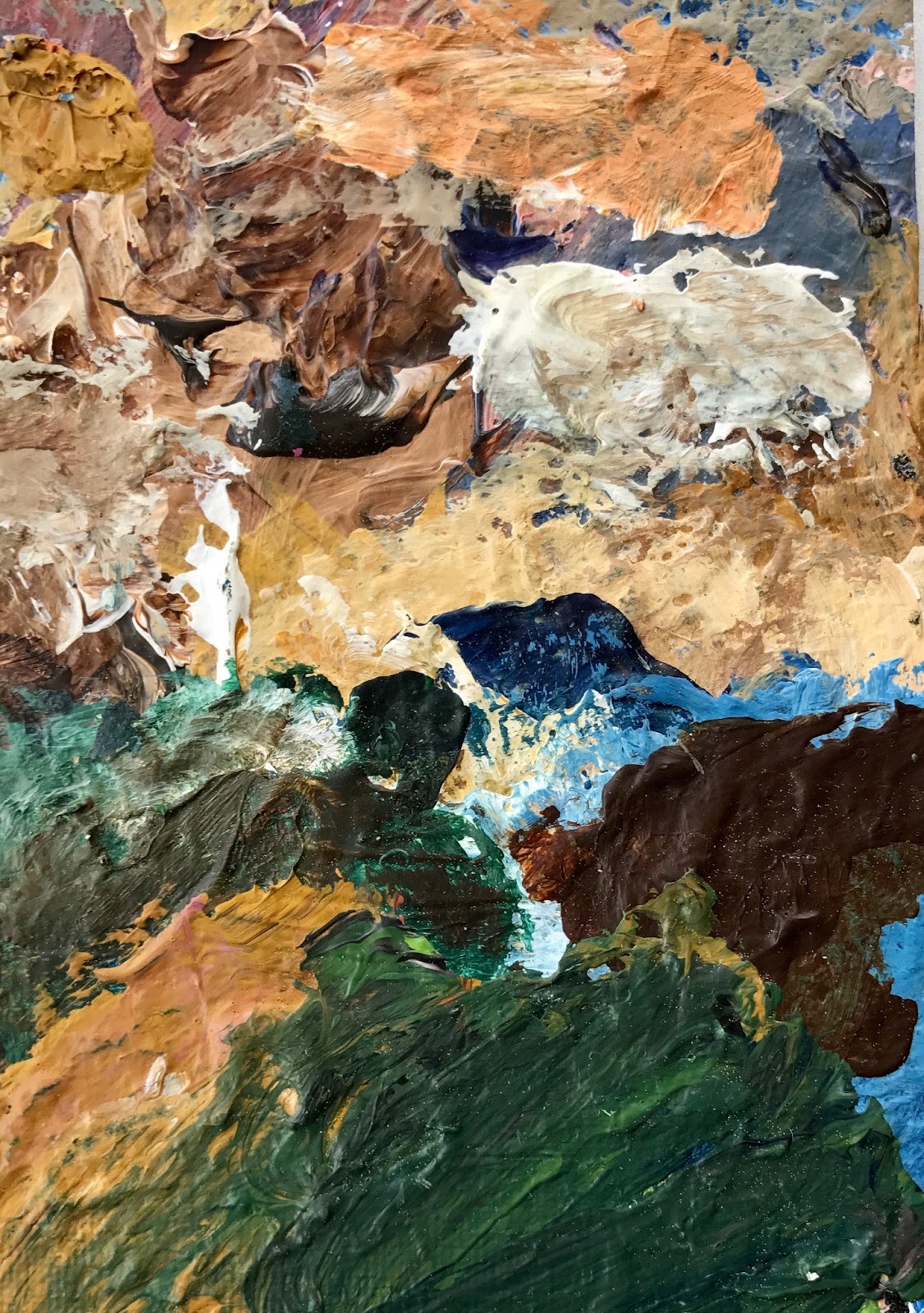
The paintig activity is still high at my balcony. So high that I had to clean my paint palette. That resulted in some interesting "paintings":

However, The real work was connected to the three acrylic paintings on Canvas:

This painting did my grandson named "The tilted Tank", when somebody else meant it shows a man sitting on a chair scratching himself with a large knife. Good responce to the style.
This painting is a variation of some of my previously prodused paintings made on demand by a friend. and called Karen´s lust. Her name is actually Karen Ylva.
The last one is an attempt to visualize part of the new skyline in Oslo; the business area Barcode at Bjørvika in the night.

Sunday, June 4

4 new painting last weeks

The spring activity at our balcony continues; playing with colors on canvas and paper.

These four paintings are partly made from scetches I did during my stay in Fuengirola October 2015 and some other motives found from friends on FaceBook. Thanks.


"Mauntain Cottage" is the name of this painting on Canvas. 50x75 cm 2.500 nok.


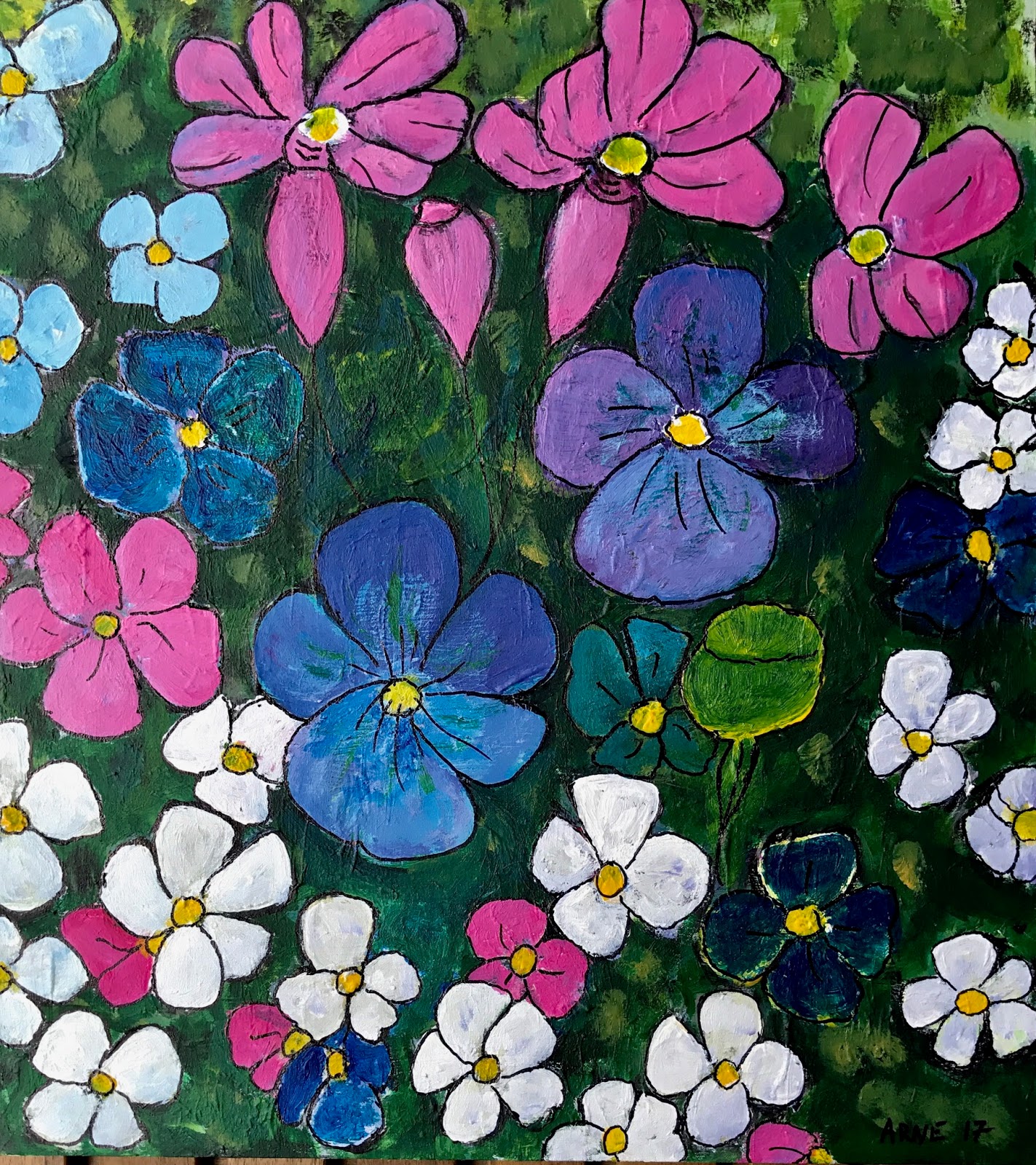
"Spring flowers" have I called this completely different painting on Canvas. 55x50 cm 1.200 nok


"Sunset" can be the natural title of this painting on Paper in front of Canvas. 50x65 cm 1.900 nok


"Hjørundfjord and Slogen" is the chosen title of this painting on Canvas. 49x64 cm 2.500 nok

You are free to come forward with other bids for these paintings. The only requirement is to collect them at my house.

Sunday, May 28

Recommending Nodee Barcode, Oslo

Sometimes we can have advantages by having some relationes to the crew and management at restaurants.   Saturday night we had that experience and received excellent service and hospitality at Nodee Barcode and Nodee Sky

We started at 13th floor for a drink before dinner at ground floor. The view over Bjørvika and the Oslo Fjord from Nodee Sky is great.


The open kitchen is remarkable and all honor to the staff for giving us a dinner far over expectation.
We will absolute call it Customer delight.


 First dish: Sashimi salad


Second: Nigri sushi of Lobster, Duck and foie gras plus Crayfish


Third: Wonton, Kimchi dumplings and King crab siu mai


Forth: Iberico ham with cabbage


Fifth: Peking Duck in three variations; Nigri,  Breast of duck in Plum sause and rapped in pancake etc.


Sixth: Chocolate fondant with ice cream and Macarons on salted caramel

Due to shellfish alergy the Chef Lung made axtra effort in serving my wife alternative dishes with same high quality all over.


Thanks to Chef Lung and his team and many thanks to Rikke recommending us to go here. The recommendation we pass on further to everyone.

Tuesday, May 16

Mid May 2017

Tomorrow we celebrate our Constitution Day; "syttende mai".

The productivity in front of the easel will therefor take a break and new chalenges have to wait until or after the weekend. However, three paintings have been signed since last blogpost.


The first painting is from our favorite view at Taberna La Oliva at Plaza de Los Chinorros in Fuengirola and is meant to express the area adound Casa Colon


The next painting I have called "The River" and is a coloristic impression of how a river flow down  the landscape.
Both the paintings are acrylic on canvas.


Painting on paper by using limited water is sometimes called paint-on-paint-water color, or only acrylic on paper. This acvarell is made on woodfree paper and shows a nightview of Akershus Fortress in Oslo

Acrylic on paper is a technique I love, so next blogpost will probably cover some of these products.

Saturday, May 6

Back in Oslo

From Fuengirola to Oslo. Back home.


We do not have all the jobs and responsibilities connected to our summer resident in the hillside of Oslo. That has been taken over by our youngest daughter and her family. Reaching the age of 70 and all the health challenges from last years, it is not so easy anymore. But visiting the cottage area and have a coffee in beautiful Norwegian weather is still a pleasure.

Downtown the Spring Auctions have started and these are some of the great paintings that will swap  owner at the end of the month.
In my own amateur studio this painting has developed, and is now awailable for a good bid.

And do we keep going to the city´s great places as in Fuengirola. Yes
At Aker Brygge there are allways tables ready for us, and to make the change from Spanish "Almuerzo" to Norwegian "Lunch" easiest, a visit to Delikatessen gives us Albondigas, Chorizo, Jamon Serano and 6 month Manchego to the tripple prizes. Larger, but Norway is expensive!