Tuesday, July 13

Happy birthday Helene 7 years

Seven years ago we got the shocking news that our first grandchild HELENE was born much too early and only ab.500gr.
Last year we presented the 6 years old girl, and Two years ago she looked like this
Three years ago I also presented the first photo of Helene, and we are very glad and proud that she today is a healthy, smart and wonderful young girl of seven years.

CONGRATULATION and HAPPY BIRTHDAY

Monday, July 12

From Castle Beach to Tullarbo

From the hot pool area at Castle Beach (temp in pool water >30C) to "sombre-22C" at Tullarbo where Rikke and family are residents this summer. They are presently on a short visit to Helsinki, Finland, so we had a nice working day up there.
However, we commend Rikke and Tor for the way they have taken care of Tullarbo and the garden this summer. They are almost fully qualified to be "have-kolonister" på Solvang 4
The Petunia flowers on the veranda is overwhelming. Partly in shadow and given enough water.

Viva España

Sunday, July 11

Home after five weeks in Spain

The beard has grown and the skin is tanned, but I´m mostly the same person who left Norway for five weeks stay in southern Spain for the second time this year. To be honest: We like Spain and Andalusia very much.
Today the beard is trimmed and it is time for reflection of the last few days at Castle Beach.We got (after three cancellations) the Flamenco performance (ok) at the stage one night, but still is Ruven Afanador´s images of the dancing queens in Malaga, the high point of this stay at Costa del Sol.The average temperatur in Fuengirola at noon was "mas o menos" like the registered figures in the city street. Sevilla reached +45C at the same time.Today´s heat can be seen at the map above, so the very few clouds we had on the sky just had to be documented.It is time to say Hasta la Vista to the estuary of the Fuengirola River and the Mediterranean Sea for this time, and hope our Spanish friends can dance and celebrate when waving the Bandera de España tonight after the World Cup final against Holland. The flag on Castillo Sohail is already showing the way.
The Sohail Castle is the landmark castle dating back to Moorish times is emblematic of Fuengirola. El Castillo Sohail stands proud on the hill, at the far end of the 5 miles of Fuengirola beach, looking straight out to sea. After the Moorish occupation, the Christians took power and the castle once again became the fortress of the town.
A Luego.

Wednesday, July 7

Last week for now

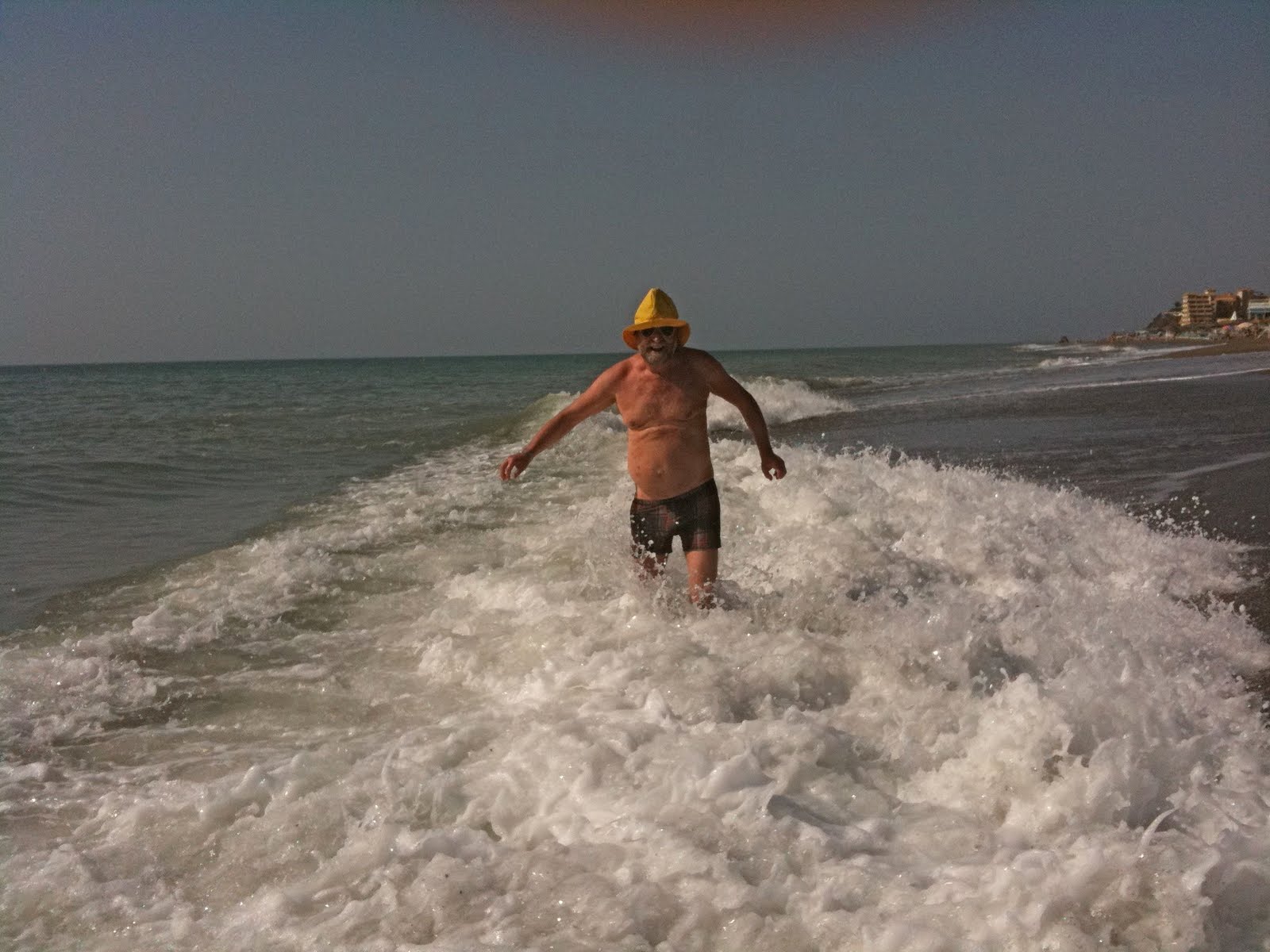
On April 18th I posted a photo of Asbjørn in his Jacuzzi with the yellow helmet we call "Sydvest". Monday morning this week I carried mine "Sydvest" when entering the Mediterranean Sea. Just for the fun of it.
The water in the jacuzzi was about 40C, but the sea down here must have been more than 25C. At least at the surface.
"Big boys" (and some girls) are cooling down in the pool with ball games.
Spain have an extreme weather situation during our stay this time too. When staying in February Andalusia had more rain than in 70 years. Now we are talking of heat above 45C at places like Sevilla and Cordoba. Here at the coast we experience daily temperatures around 35C. Only two grey days in 5 weeks.
Tullen is approaching the big waves at the beach.Passing the breakers it is lovely to ride on the top of waves. The only challenge is how to get ashore.
This time the tsunami caught her. I do not need to show you a photo of the wet hair and ripped-off bikini. Believe you, as we, remember the horrible Tsunami in Asia. The power of the sea-waves are tremendous. Blue energy?

Sunday, July 4

At last, a day with grey sky

23 days with no clouds on the sky.
Yesterday morning we woke up to +22C and a grey sky.
What else could we do than expand our morning walk to 12 km.At the turning point after 60 minutes walk a short photo-break was permitted.
Almost home a call from Anton and Grethe added another 3 km walk for strolling the city (and some shopping) and having lunch at The Crispy Cod. Fish and chips at a very high quality (Anton is in the business and should know) and our recommendation to all if visiting these beaches.

With Germany´s and Spain´s victories in the Football World Cup later this Saturday the grey sky (with some warm rain) ended with bright stars and a bottle of Delapierre Cava

Today we are back to normal. Blue sky all over and ready for the swimming pool and some reading hours in the shade of the sombreros.

Tuesday, June 29

Spania 1 - Portugal 0

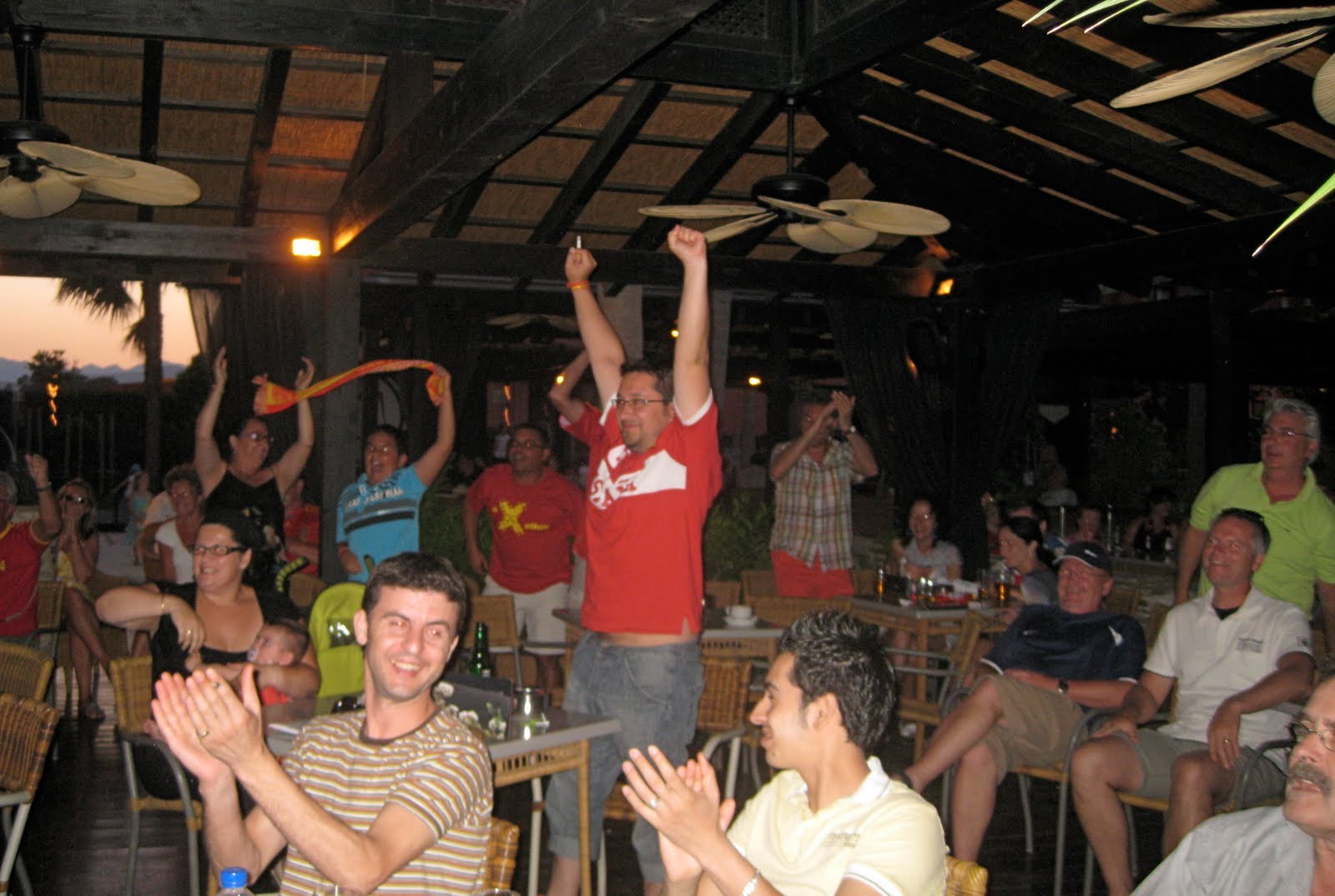
Flamenco show cancelled again, but the reaction of Spanish friends when David Villa scored the only goal and gave Spain the quarter final position, may be Flamenco good enough.At least it gave me the opportunity to get "dos copas de vino blanco" from the bar.The intended Flamenco photos must be replaced by another Ruven Afanador photo. Flamenco passion more than enough.

Malaga, an Exciting city

Ruven Afanador´s exhibition "Mil Besos" (thousand kisses) of great photos in Paseo del Parque in the heart of Malaga Andalusia, should be a reason to visit the town whatsoever.
Malaga is an exiting city, with old and modern environment.At noon the temperature outside the tunnel under the Alcazaba castle and Castillo de Gibralfaro was as shown on the photo: + 26C. Later that day the heat increased.In the main shopping street Marques de Larios they have found a way to handle the heat. By covering the opening between the shops and beautiful buildings with sails the reduction of the sun beams became satisfactory. We also felt a gentle breeze going through the street.At Plaza de Toros the young Toreros (novilleros) are training with their Muletas. Some of the persons are pretending to be a bull with long horns, ( I was not taken as a bull!) but most of the training is how to dance around with the red cape.
The red color of the muleta is actually unnecessary, though, as bulls are dichromatic, meaning neither the cape nor the muleta color can be accurately discerned by the bull. The color is retained merely for tradition.The colors of the Can-Can dancers dresses at the night show are however carefully chosen by layout designers to improve the visual effect of speed and rythm . The Can-Can achieved popularity in music halls, where it was danced by groups of women in choreographed routines. This style was imported into France in the 1920s for the benefit of tourists, and the French Can-Can was born—a highly choreographed routine lasting ten minutes or more, with the opportunity for individuals to display their "specialities". The main moves are the high kick or battement, the rond de jambe (quick rotary movement of lower leg with knee raised and skirt held up), the port d'armes (turning on one leg, while grasping the other leg by the ankle and holding it almost vertical), the cartwheel and the grand écart (the flying or jump splits).To night we will visit a Flamenco show, and look forward to see if this performance in any way can compete with Ruven Afnador´s images.

Sunday, June 27

World record: 40.45 meters

As I posted earlier this week, the builders of Slinning bonfire 2010 went for a world record. They made it!
40,45 meters is the new world record, higher than a ten stores building. Congratulation.
More photos here.

Thursday, June 24

The day after, and tomorrow a new challenge

Today it is "St. Hans" and the weather is ready for celebration.
In Spain they celebrate the San Juan Night and during last night young people was gathering around bonfires and partying at the beaches.
However, celebrating in the darkness of the night is one thing. What we could see on our morning exercice today was a complete different thing. Remains, trash and garbage all over. Environmental concern has a double face. You act when others can see you. In the dark you just leave the trash. Improvement please!!
In Ålesund they still are building the "Slinning bonfire" for the local celebration of mid-summer the coming weekend. I have "stolen" two photos from Staale Wattø´s photoserie about the coming World record: > 40 meter high.Read Sunnmørsposten for the result later this week.

Tuesday, June 22

Morning Swimming like Ursula A. and Sean C.

My first plan for today blogpost was to send a special greeting to Trøndelag and the ladies searching for old wood at the sea shore. Maybe a tour to Cordoba would be interesting for them, watching the 2000 years remains after ceilings in the old great mosque, the Mezquita.
First, the Romans built a pagan temple on the site. After the fall of the Roman Empire, the new Germanic masters of Spain (the Visigoths) replaced it with the Christian church of Saint Vincent. When the Arabs conquered the peninsula in the early 8th century, they tore down the church and began building their great mosque, which - commensurate with Cordoba's importance as the centre of Muslim power in Spain - became the largest mosque in all of Islam after that of Caaba, in Arabia: the Mezquita
However watching my wife climbing out of the water an early morning like Honey Rider in the movie Dr. No from 1962, I had to add these two other photos as well.The evidence of 7.30 am bathing is hereby given.

Sunday, June 20

From Spain to Guyana

Tonight, when the dark sky full of stars and a half moon was covering our balcony I received a new visitor from the north east of South America, Guyana.
I do not know much about dansing in Guyana, but at our pool bar these dancers made an acceptable performance when performing Pasodoble etc.
Modern Guyana is bordered to the east by Suriname, to the south and southwest by Brazil, to the west by Venezuela, and on the north by the Atlantic Ocean.
At 215,000 km2, Guyana is the third-smallest independent state on the mainland of South America (after Uruguay and Suriname). Its population is approximately 770,000. It is one of the four non-Spanish-speaking territories on the continent, along with the countries of Brazil (Portuguese), Suriname (Dutch), and French Guiana (French).
The flag of Guyana, known as The Golden Arrowhead, was adopted in 1966. It was designed by Whitney Smith, a prominent American vexillologist . The colours are : green for agriculture and forest, white for rivers and water, gold for mineral wealth, black for endurance, and red for zeal and dynamism.
The visitor from Guyana (my 153 flag) was one of 52 new unique visitors yesterday.

Friday, June 18

Cordoba - Mesquita and "almost nothing" more

Cordoba old town was both a positive and a negative experience. It was an Iberian and Roman city in ancient times. In the Middle Ages it was a capital of an Islamic caliphate and one of the largest cities in the world. In the 10th-11th centuries Córdoba was one of the most advanced cities in the world, as well as a great cultural, political, financial and economic centre.
Its population in 2008 was 325,453.
Córdoba was conquered by the Romans in 206 BC. In 169 the Roman consul Marcus Claudius Marcellus founded a Latin colony alongside the pre-existing Iberian settlement. The Roman bridge over the banks of the Guadalquivir river (Rio Grande), leads the way into the old town.I would say that except the huge Mesquita (Cathedral of Our Lady of the Assumption) the old town is only a place to eat local food and have a drink if you are not interested in tourist objects.The great mosque dates back to the time under caliph Al-Hakam II . Córdoba received what was then the largest library in the world, housing from 400,000 to 1,000,000 volumes. The photo above is from Patio de los Naranjos with the Bell Tower.
The double Arabic arches cover the ceiling of the "mosque". However, the cathedral of Cordoba is not a mosque or simply a monument or a temple of different cultures. It is a living church which carry the human history in it´s walls by thousands of years.
Under the cathedral we can see remains of mosaics from the ancient Basilica of Saint Vicente, and they have also discovered remains of it´s Visigoth origins. The (Visi)Goths are among the barbarians who disturbed the late roman empire during the Migration Period. They first emerged as a distinct people during the fourth century, initially in the Balkans where they participated in several wars with Rome. A Visigothic army under Alaric I eventually moved into Italy and famously sacked Rome in 410.
The Goths have had many names, possibly due to their population being composed of many separate ethnic groups. People known by similar names were key elements of the Germanic migrations. Nevertheless, the mainstream of scholarship believes that the names derived from a single prehistoric ethnonym owned by an uniform culture of south Scandinavia in the middle 1st millennium BC, the original "Goths". People with a modern form of that name still reside there.

Once again we can see the link back to the to Thor Heyerdahl´s Norwegian mythology which tells that the Scandinavian god Odin moved with his people to Norway from a land called Aser (from Azerbaijan, east of the Caucasus mountains and the Black Sea.), in order to avoid Roman occupation.
The mihrab ( محراب ) is a niche in the wall of a mosque that indicates the qibla; that is, the direction of the Kaaba in Mecca and hence the direction that Muslims should face when praying.
Mesquita is not any longer defined as a mosque and the church-mihrab is placed in a north-south direction, while Mecca is south-east. We were told that is is not allowed to perform islamic prayers in Mesquita. It is defined as a catholic church.
The main alterpiece in the cathedral inside the mosque made by Alonso Matias.
The ceiling (Dome) above the main chapel (work started in 1523), is a beautiful artwork.
Among the treasury in the cathedral we can see crosses from 15th, 16th, 17th and the 18th century together with an ivory sculpture of INRI.In the chapel of Saint Theresa you may find many beautiful treasures from the GOLDEN periode of Spain.
Maimonides also known as Rambam was a preeminent medieval Jewish philosopher, one of the greatest Torah scholars of the Middle Ages. He was born in Córdoba, and honored with a staue.
Maimonides promoted and developed the philosophical tradition of Aristotle, which gave both men prominent and controversial influence in the West, where Aristotelian thought had been lost for centuries. Albert the Great and Thomas Aquinas were notable Western readers of Maimonides.

However, any tour at a UNESCO World Heritage Site must end, and what is better than going to a local restaurant for lunch. At least I found that very important when the temperature outside is about +33C to +35C.